The birthday problem is a classic probability puzzle that demonstrates how likely it is for at least two people in a group to share the same birthday. While it might seem intuitive that the probability is low in small groups, the results are surprising.
Example 5.1 In a group of \(k\) people, what is the probability that at least two people share the same birthday? Assume (1) there are 365 possible birthdays; (2) birthdays are evenly distributed across the year; (3) people are equally likely to be born on any given day.
Solution. If \(k>365\), the probability is \(1\). Assume \(k\leq365\) for the rest. Instead of directly calculating the probability of at least two people sharing a birthday, we first compute the complementary probability, \(P(\text{no match})\) , where no two people in the group have the same birthday.
For the first person, there are 365 choices for their birthday. For the second person, to avoid a shared birthday, there are 364 remaining choices. For the third person, there are 363 choices, and so on. For \(k\) people, the total number of arrangements (no shared birthday) is:
Thus, the probability of at least one matched birthday is: \[P(\text{match})= 1- P(\text{no match})=\begin{cases}
50.7\% & k=23\\
70.6\% & k=30\\
97.0\% & k=50\\
99.9\% & k=70
\end{cases}\]
R simulation
# a class of k people k <-30# number of experimentsN <-1000# number of matchesm <-0for (i in1:N) {# draw k random numbers from 1 to 365 with replacement birthdays <-sample(1:365, k, replace = T) # number of duplicated birthdays dups <-duplicated(birthdays)# if duplicated birthdays foundif (any(dups)) m <- m +1}cat("Prob of at least one match: ", m / N)
Prob of at least one match: 0.693
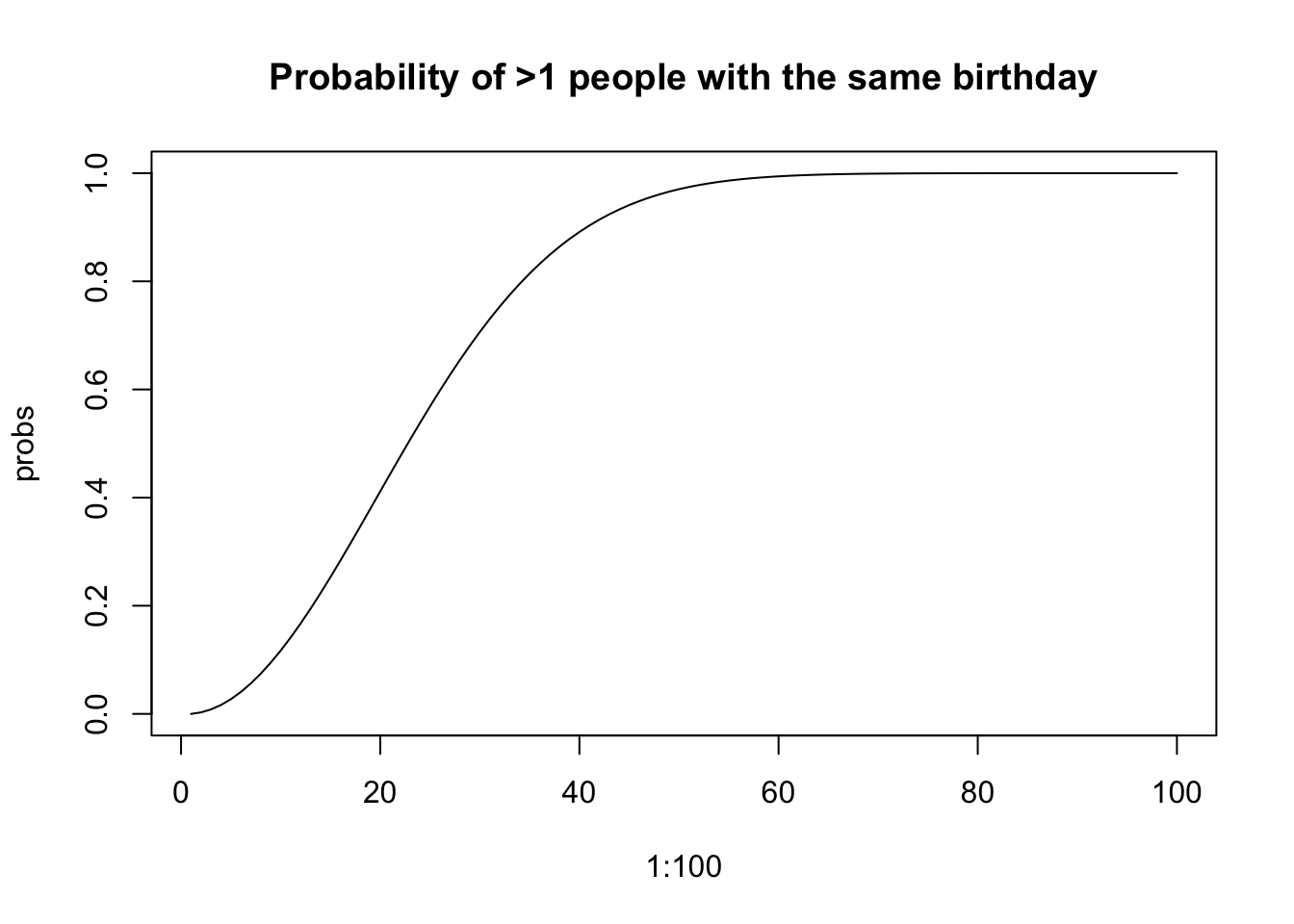
There is even a built-in function pbirthday that computes the probability of birthday coincidence. We may utilize this function to plot the probability as the number of people increases.
# compute the probability of birthday match for 30 peopleprob <-pbirthday(30) # compute a vector of probabilities for 1,2...100 peopleprobs <-sapply(1:100, pbirthday)# make a plotplot(1:100, probs, type="l",main ="Probability of >1 people with the same birthday")