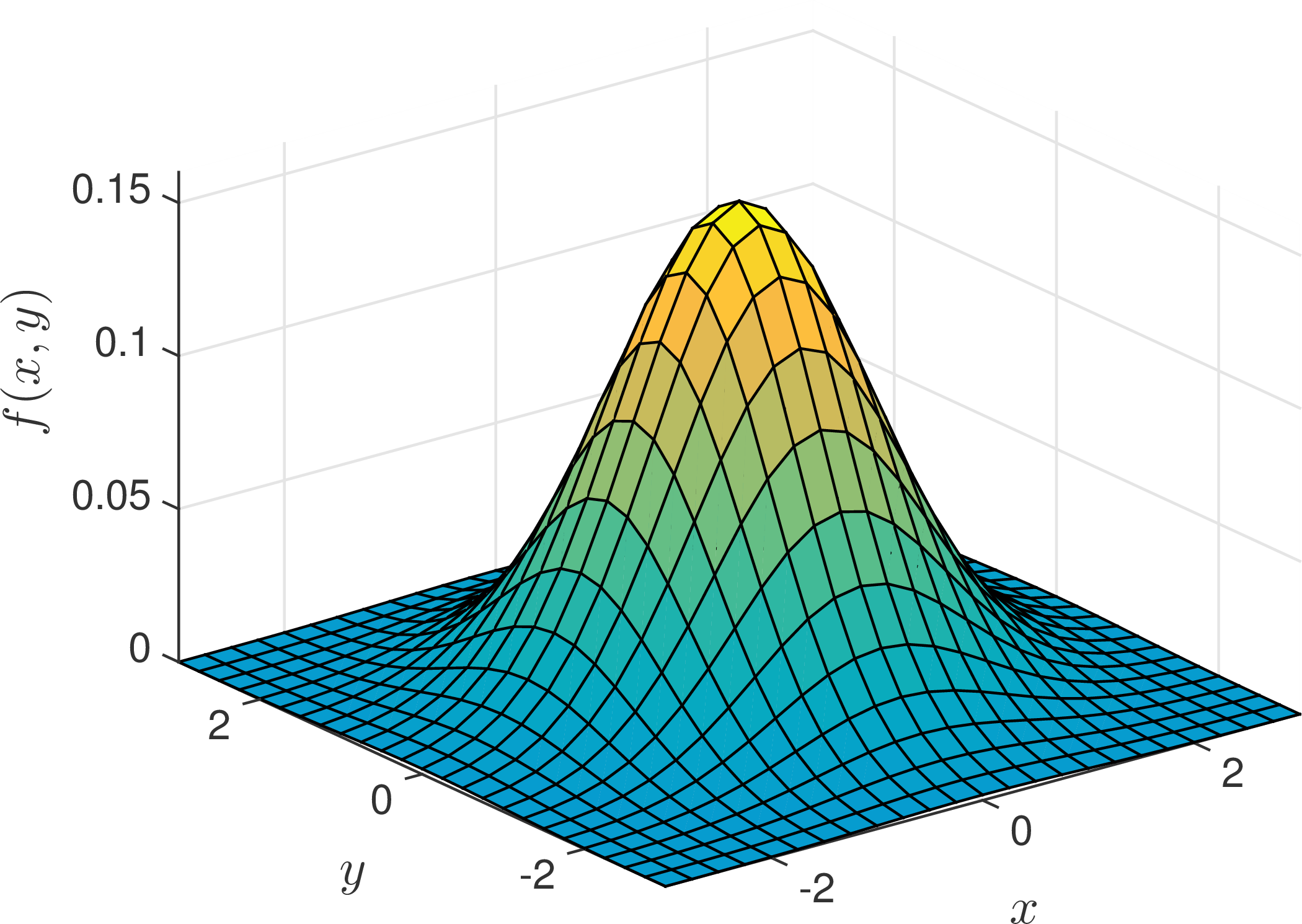
Definition 48.1 (Bivariate normal distribution)\((X,Y)\) is said to have a Bivariate Normal distribution if the joint PDF satisfies \[f(x,y)=\frac{1}{2\pi\sqrt{1-\rho^{2}}}\exp\left(-\frac{1}{2(1-\rho^{2})}(x^{2}+y^{2}-2\rho xy)\right)\] where \(\rho\in(-1,1)\) is the correlation between \(X\) and \(Y\).
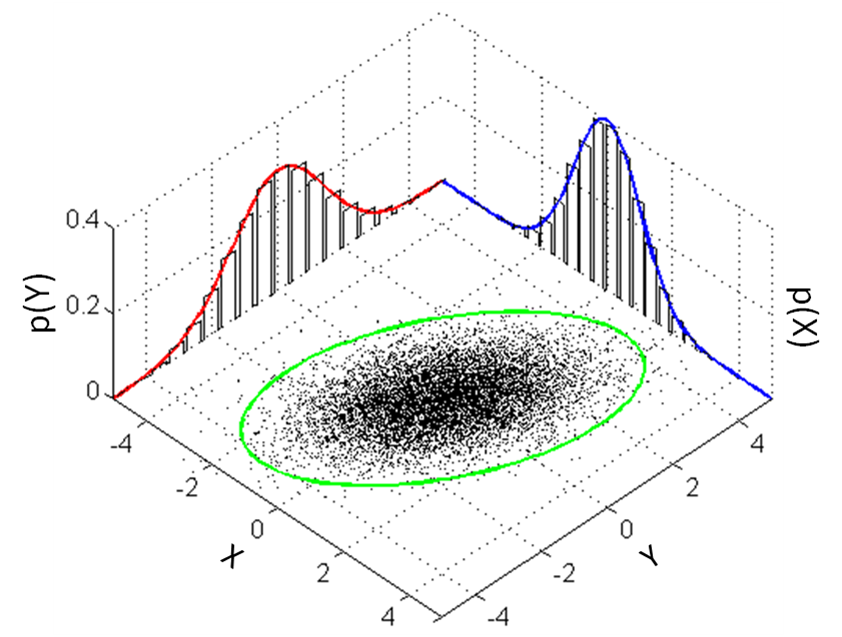
Multivariate Normal (MVN) is an extension of the bivariate normal distribution to \(n\)-dimensional variables. We skip the joint PDF here since it is too complicated. But like the bivariate case, an MVN is fully specified by knowing the mean of each component, the variance of each component, and the covariance between any two components.
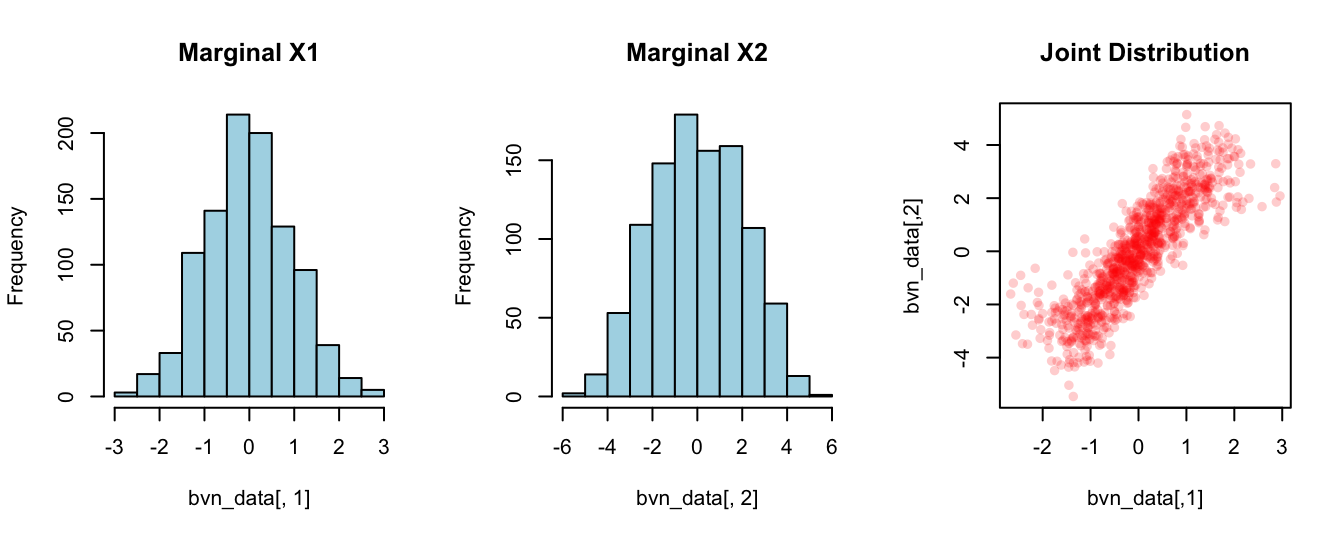
Marginal normality does not imply joint normality
If \((X_{1},...,X_{k})\) is MVN, then the marginal distribution of every \(X_{j}\) is Normal. However, the converse is false: it is possible to have Normally distributed \(X_{1},...,X_{k}\) such that \((X_{1},...,X_{k})\) is not Multivariate Normal.
# Load necessary librarylibrary(MASS)# Set seed for reproducibilityset.seed(123)# Generate bivariate normal databvn_data <-mvrnorm(n =1000, mu =c(0, 0), Sigma =matrix(c(1, 0.5, 0.5, 1), nrow =2))# Modify the joint distribution: apply a nonlinear transformationbvn_data[, 2] <- bvn_data[, 2] +2*sin(bvn_data[, 1]) # The marginal distribution remains normalpar(mfrow =c(1, 3))hist(bvn_data[, 1], main ="Marginal X1", col ="lightblue")hist(bvn_data[, 2], main ="Marginal X2", col ="lightblue")# But the joint distribution is not normalplot(bvn_data, main ="Joint Distribution", pch =16, col =rgb(1,0,0,.2))
Theorem 48.1 A random vector \((X_{1},...,X_{k})\) is Multivariate Normal if every linear combination of the \(X_{j}\) has a Normal distribution (\(X_{j}\) do not have to be independent). That is, we require \(t_{1}X_{1}+\cdot\cdot\cdot+t_{k}X_{k}\) to have a Normal distribution for any choice of constants \(t_{1},...,t_{k}\).
Theorem 48.2 In general, uncorrelated does not imply independent. But with an MVN random vector, uncorrelated implies independent. In particular, if \((X,Y)\) is Bivariate Normal and \(\rho_{XY}=0\), then X and Y are independent.
Theorem 48.3 If \((X,Y)\) is Bivariate Normal, then the conditional expectation satisfies \[E(Y|X)=E(Y)+\frac{Cov(X,Y)}{Var(X)}(X-E(X)).\]
In other words, \[E(Y|X)=a+bX\]where \(b=\frac{Cov(X,Y)}{Var(X)}\) and \(a=E(Y)-bE(X)\).
This is exactly the case in Definition 40.2, where we assume the conditional expectation \(E(Y|X)\) is a linear function of \(X\). This assumption is true when \((X,Y)\) are jointly normal. Otherwise, the assumption might not be reasonable. In practice, we don’t know precisely the joint distribution of variables. The linear model is just a simplified assumption.