The beauty if approximating discrete problems by continuous function is that it makes calculation easier. Now we revisit the birthday problem with Poisson distribution.
Example 28.1 If we have \(m\) people and \(\binom{m}{2}\) pairs. Each pair of people has probability \(p=1/365\) of having the same birthday. Find the probability of at least one match.
Solution. The probability of match is small, and the number of pairs is large. We consider using the Poisson paradigm to approximate the number \(X\) of birthday matches. \(X\approx Pois(\lambda)\) where \(\lambda=\binom{m}{2}\frac{1}{365}\). Then the probability of at least one match is \[P(X\geq1)=1-P(X=0)\approx1-e^{-\lambda}.\] For \(m=23\), \(\lambda=253/365\) and \(1-e^{-\lambda}\approx0.5\), which agrees with our previous finding that we need 23 people to have 50% chance of a birthday match.
Example 28.2 Continued with the assumption above. What’s the probability of two people who were born not only on the same day, but also at the same hour and the same minute?
Solution. This is the birthday problem with \(c=365\cdot24\cdot60=525600\) categories rather than \(365\) categories. By Poisson approximation, the probability of at least one match is approximately \(1-e^{-\lambda_{1}}\) where \(\lambda_{1}=\binom{m}{2}\frac{1}{525600}\). This would require \(m=854\) to reach the break even point, 50% chance of getting a match.
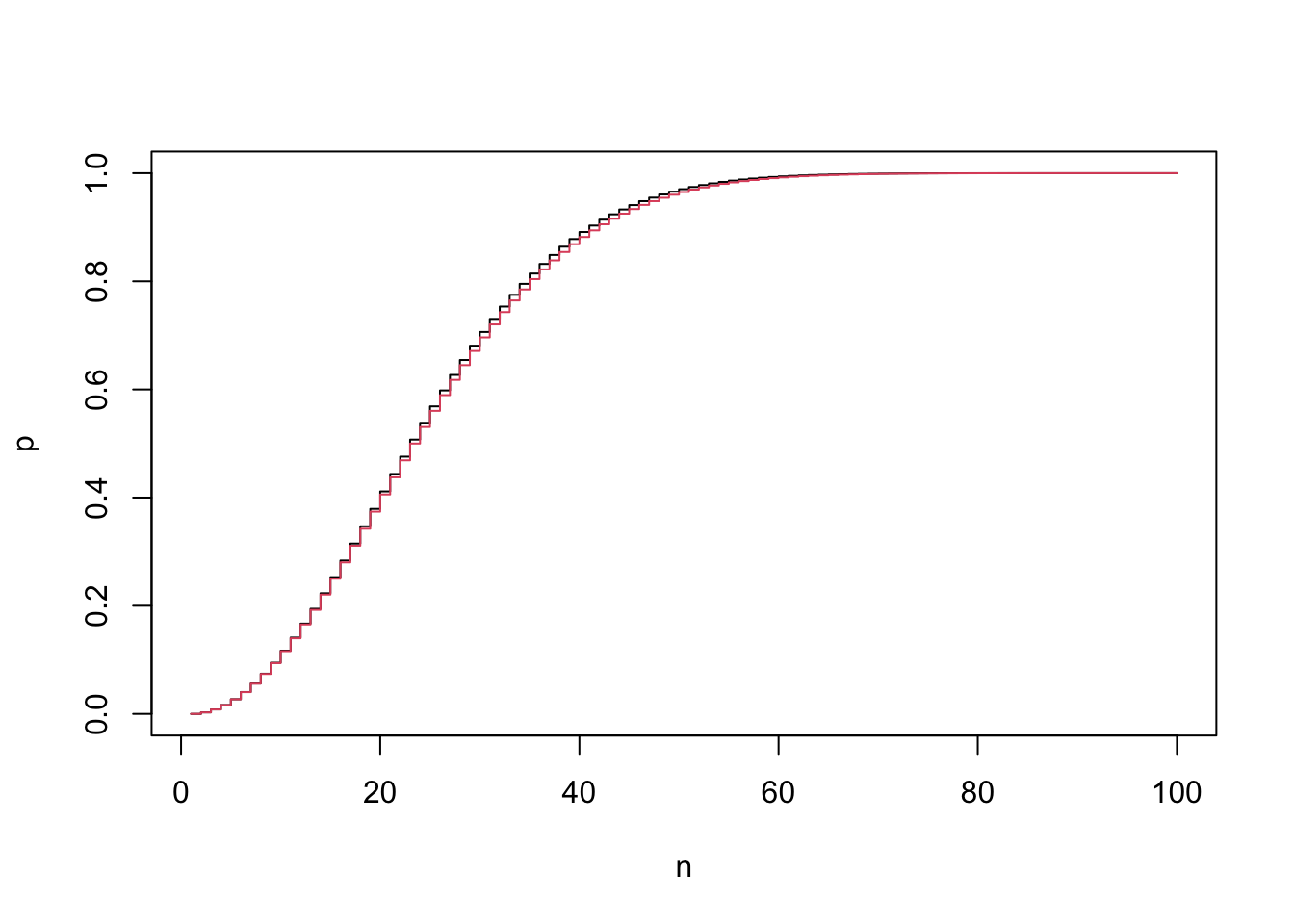
You may wonder how good the Poisson approximation is. We can compare it with the true values.
# compute the probability of coincidences for 1,2...100 peoplen <-1:100p <-sapply(n, pbirthday)# approximate the probability by Poisson paradigmlambda <-choose(n, 2)/365q <-1-exp(-lambda)# black line is the true probability# red line is the Poisson approximationplot(n, p, type ="s")lines(n, q, col =2, type="s")